Extending the corridor to Vancouver Island
Burrard Thermal is the anchor of BC's hydrogen production corridor. The former Domtar Crofton mill is in active consideration as the parallel Vancouver Island node.
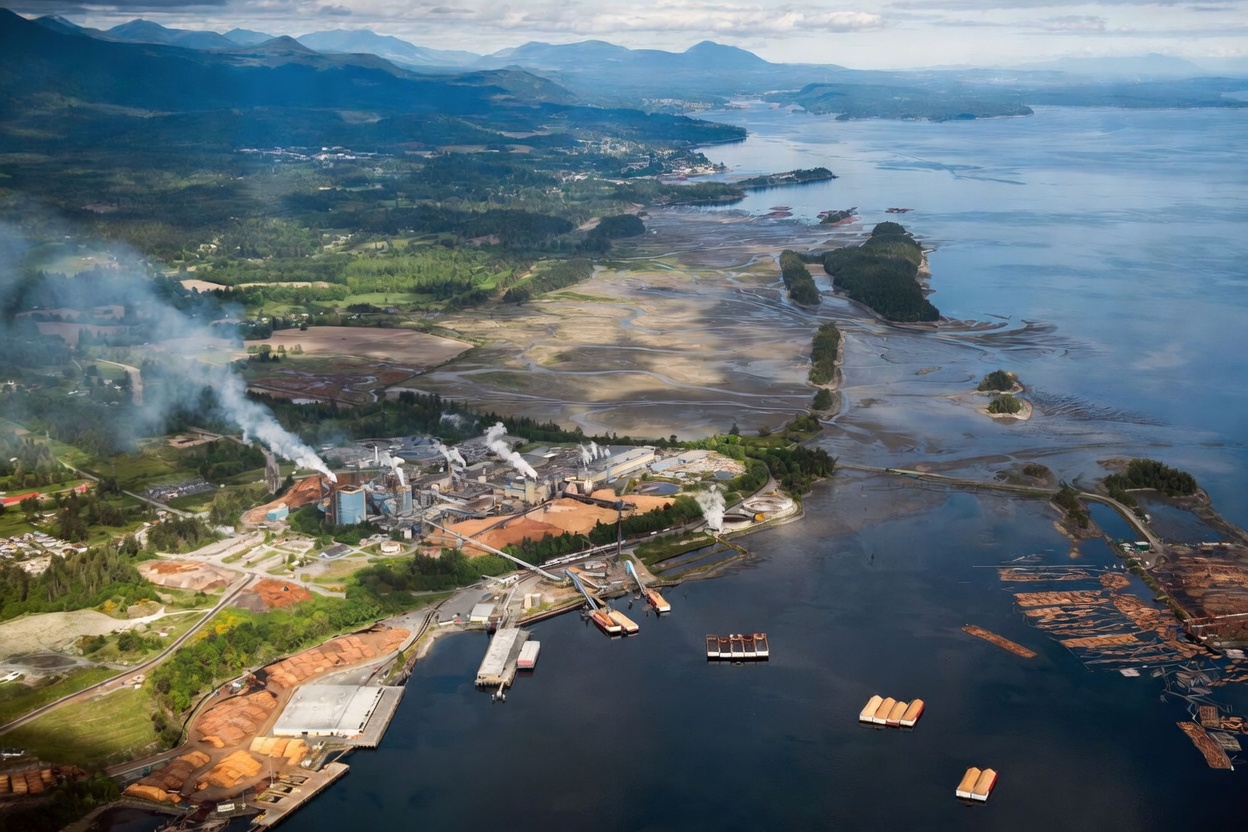
The Crofton site — 107 hectares of waterfront industrial land with grid interconnection, deep-water port, natural gas pipeline, and biomass handling already in place. Looking east across Stuart Channel toward Saltspring Island.
Why Crofton
PDEC is a corridor, not a single project. Each site serves its own catchment; together they form one network.
Vancouver Island geography
On-island production serves Island offtakers directly. No barging across the Strait of Georgia for every delivery.
Infrastructure already built
138 kV grid, 61.5M m³/yr water licence, deep-water dock, FortisBC gas pipeline, biomass handling. Not a greenfield.
Independent economics
Crofton and Burrard each stand on their own numbers. Corridor synergy is additive, not required.
What we're proposing
Three hydrogen production pathways operating from day one. Each uses what the site enables.
PEM Electrolysis
Share: 50% | Output: 12,926 kg/day
32 MW on BC Hydro 138 kV interconnection. Grid is 98% clean.
Methane Pyrolysis
Share: 30% | Output: 7,756 kg/day
~7.5 TPD Ekona xCaliber on existing FortisBC pipeline. Solid carbon byproduct.
Biomass + BECCS
Share: 20% | Output: 5,170 kg/day
~5 TPD from coastal slash piles. Carbon-negative with BECCS.
Production & revenue flow
Four feedstocks flow through three production processes (electrolysis + pyrolysis + biomass+BECCS) into products, an e-fuel synthesis layer (methanol, bio-LNG, renewable diesel), and offtakers + co-product markets. All flows in $M CAD/yr. Hover any node to trace its connections.
The numbers
Phase 1 base-case economics. All figures CAD.
Pathway economics
| Pathway | Share | Output (kg/day) | Gross LCOH | Net LCOH |
|---|---|---|---|---|
| PEM Electrolysis | 50% | 12,926 | $4.79/kg | $4.79/kg |
| Methane Pyrolysis | 30% | 7,756 | $2.50/kg | -$2.00/kg (carbon credit) |
| Biomass + BECCS | 20% | 5,170 | $4.00/kg | $3.20/kg (biochar + seq) |
| Blended | 100% | 25,852 | — | $3.03/kg |
Capex
PDEC revenue (base case, per year)
| H2 sales (9.44M kg at $5/kg gate price) | $47.2M |
| BC Low Carbon Fuel Standard credits | $18.0M |
| Solid carbon byproduct | $12.7M |
| Oxygen byproduct | $5.7M |
| District heat | $3.3M |
| Grid services | $1.5M |
| Biochar byproduct | $0.6M |
| Sequestered CO2 credit | $0.9M |
| Total PDEC revenue | $89.9M |
| Plus diesel savings captured by offtakers (beyond $5/kg gate) | +$46.6M |
| Plus social value (carbon + healthcare externalities) | +$67.4M |
| Total annual economic value created | $203.9M |
PDEC revenue is what PDEC actually earns. Diesel savings and social value represent benefits accruing to offtakers and society respectively, on top of PDEC's sale price.
Environmental impact
Who we'd serve
Vancouver Island addressable demand at PDEC's $4-5/kg target gate price: approximately 33,000 kg/day. These are fleet-size estimates, not signed contracts.
Marine & ferry
BC Ferries Route 6 (candidate anchor pilot, terminal at the mill gate). MV Coho. Canadian Coast Guard Pacific. Marine industrial.
Transit & road
Cowichan Valley Regional Transit (Duncan depot is CNG-ready). Victoria Regional Transit. CRD/CVRD/RDN heavy fleets. Mosaic forestry trucks. BCEHS, Island Health.
Industrial
Western Forest Products Chemainus (kiln blending). Catalyst Paper Port Alberni. Coastland Wood. FortisBC gas blending.
Defense, federal & flagship
GVHA Ogden Point cruise terminal (H2 power barge alternative to abandoned $159M shore-power project). CFB Esquimalt. CFB Comox. CCG Pacific. DFO, RCMP, ECCC.
Core thesis: operators pivoting to battery-electric aren't rejecting hydrogen on technical grounds — they're rejecting $14-16/kg retail pricing. At $4-5/kg delivered, the math flips. PDEC creates the supply; demand follows.
Working with First Nations
The Crofton site is on unceded Quw'utsun territory. Halalt, Cowichan Tribes, Penelakut, and Lyackson hold interests. Indigenous partnership is structural, not afterthought.
Cowichan 2025 decision
Cowichan Tribes v. Canada (AG), 2025 BCSC 1490 — first Canadian ruling recognizing Aboriginal title over fee-simple land. It changes the transaction structure for any industrial acquisition in BC.
Equity partnership
Target: 25-49% Indigenous equity via the federal $5B Indigenous Loan Guarantee Program + BC's $1B Equity Financing Framework. Kruger Kamloops and Hydrogen Naturally Fort Nelson as precedents.
How we engage
Dr. Matt Murphy (UVic Gustavson, Balance Co-Lab) leads engagement under FPIC protocols. Water and weir governance structured through the Cowichan Watershed Board. No acquisition without a DRIPA-compliant framework.
What it means for the community
The mill closure displaced ~500 workers and removed the largest taxpayer. Replacement has to answer for jobs, taxes, and the village water utility.
Jobs
Approximately 40 direct operations FTEs at Phase 1 steady-state (per model staffing budget), plus construction-phase employment and ongoing indirect employment across feedstock supply, maintenance contractors, and logistics. Process control, trades, and power systems skills transfer directly from mill to hydrogen operations.
Municipal tax base
Industrial redevelopment restores North Cowichan's largest single tax contribution. Intent: return the site to its historical role as the principal employer and taxpayer.
Village water utility
Dec 31, 2026 deadline: Domtar's commitment expires. PDEC proposes a funded tripartite transition to the appropriate municipal authority with CVRD and North Cowichan, not indefinite operator responsibility.
Cowichan Lake weir
Proposed transfer of weir operations and water licence to the Cowichan Watershed Board. PDEC accesses water under commercial supply agreement rather than by holding the licence.
Infrastructure already in place
Crofton is not a greenfield. Decades of heavy-industrial buildout stay in service.
Electrical
Two dedicated 138 kV BC Hydro circuits terminate at the site, ~9 km from Vancouver Island Terminal. No new substation capex.
Water
~61.5M m³/yr licensed on the Cowichan system. Phase 1 electrolyzer demand is <1% of volume. Seasonal drought, not volume, is the constraint.
Marine terminal
Three Panamax-capable berths on Shoal Island (136-163m length, 9.2-10.8m depth). Supports barge distribution corridor synergy.
Natural gas pipeline
FortisBC high-pressure pipeline on-site. Feedstock for pyrolysis — no new pipeline construction or permitting.
Biomass handling
Existing bunkers, conveyors, drying systems from ~87% biomass energy operation. Adaptable to the biomass-to-hydrogen pathway.
Zoning & land
107 hectares (264 acres) of heavy-industrial zoned waterfront land. North Cowichan OCP supports marine + industrial. No rezoning required.
Risks we acknowledge
An honest stakeholder-facing summary. Click any card for detail on how we address each risk.
Environmental remediation
68 years of kraft pulp. BC EMA liability is absolute and retroactive. Baseline estimate $40-85M. Addressed via indemnification, phased remediation with AiP, PLL insurance, and ring-fenced project-cos.
Water licence transfer
WSA prioritizes environmental flow; Cowichan Watershed Board co-governance applies. Addressed via multi-season baseline monitoring, wastewater reclamation, and SWRO drought backup.
Indigenous consent (critical path)
Post-Cowichan 2025, DRIPA-compliant IBA required before construction debt. Addressed via 25-49% Indigenous equity via ILGP, FPIC protocols, no acquisition without framework.
BC Hydro interconnection
Mill operated as load displacement. CBLI System Impact Study confirms deliverable capacity. Tri-pathway architecture reduces single-point dependency on electrolysis load.
Village water utility deadline
Dec 31, 2026 handover. Addressed via tripartite transition plan with CVRD and North Cowichan, funded assistance, separate utility project-co.
Supply chain lead times
Electrolyzer stacks 18-24 months, specialized transformers similar. Addressed via early orders with partial payment pre-FID and dual-sourcing where viable.
Status and timeline
In consideration today. Pre-development workstreams active. Phased build-out from 2028.
Phase 0
Indigenous engagement + IBA. BC Hydro CBLI. Phase I/II ESA. Water flow monitoring. Offtaker LOIs. Village water transition planning.
Phase 1
FID. Tri-pathway build-out: 32 MW PEM + 7.5 TPD pyrolysis + 5 TPD biomass+BECCS. BC Hydro upgrades. Commissioning. First offtakers (Route 6 pilot, CVRT, WFP).
Phase 2
Offtaker expansion (Victoria Transit, CFB Esquimalt, CCG, GVHA cruise-terminal barge). Mainland barge corridor activation. Byproduct revenue scaling.
Phase 3
Full corridor operations. Export-scale green industrial products. Expanded federal + defense commitments.
Get involved
First Nations, offtakers, municipal partners, unions, community stakeholders, and prospective co-investors — reach out.
Email info@pdec.ca Crofton Executive Brief (PDF)